
Why SB1958 / HB1971 Demand Clarity from Republican and Democrat Party Leadership
Political parties are not departments of the State. They are voluntary associations which claim that they are formed around shared principles. They are protected by the First Amendment’s guarantees of speech and association. That constitutional protection is not symbolic. It is substantive. It safeguards a party’s authority to define its membership, articulate its platform, determine standards of good standing, and decide who represents the party as its official candidate.
At a time when Republican Legislation are pushing SB1958 and HB1971 which propose significant restrictions on the ability of citizens to seek judicial review of state statutes, party leadership faces a question that is not merely political—it is institutional and constitutional. If a party’s platform affirms fidelity to constitutional governance, the rule of law, and the protection of individual rights, then legislation affecting access to judicial review necessarily implicates those commitments.
Consequently, the question is not whether disagreement is permitted. Of course it is. The question is whether a political party retains the authority — and the responsibility — to define the boundaries of its own identity when legislative action conflicts with declared principles. This is critical when legislators are claiming power and authority as members of the political party itself.
THE CONSTITUTIONAL AUTHORITY OF POLITICAL PARTIES
The United States Supreme Court has repeatedly affirmed that political parties possess constitutionally protected associational autonomy. In Democratic Party of the United States v. Wisconsin ex rel. La Follette (1981), the Court held that a state could not compel a national political party to seat delegates selected through a process inconsistent with party rules. The decision reaffirmed that parties control their own internal governance.
In Tashjian v. Republican Party of Connecticut (1986), the Court struck down a state law that prevented a political party from determining who could participate in its primary. The Court emphasized that defining the boundaries of association is central to First Amendment protection.
In California Democratic Party v. Jones (2000), the Court invalidated California’s blanket primary because it forced political parties to allow non-members to participate in selecting nominees. The ruling made clear that compelled association burdens core constitutional rights.
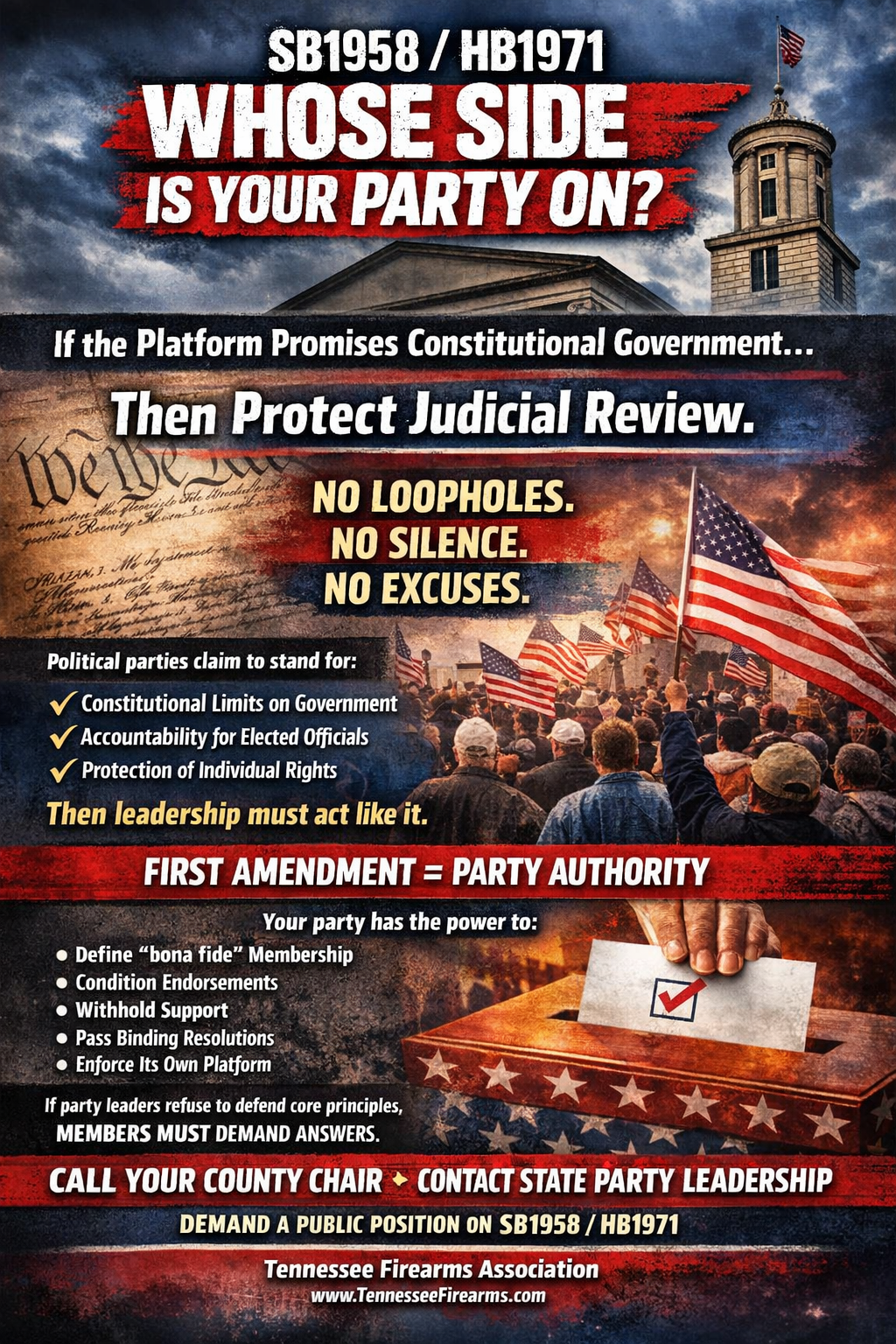
These cases stand for a consistent principle: Political parties—not the state—define their membership, their standards of participation, and the criteria for representation under their banner. While some Tennessee Legislators support laws that try to micromanage party choices, the party’s authority, shielded by the First Amendment, includes:
- Defining what constitutes “bona fide” membership or a member in good standing;
- Establishing internal rules for endorsements and recognition;
- Adopting resolutions clarifying the party’s principles;
- Conditioning party resources and support on adherence to platform commitments.
This associational autonomy is robust, though not unlimited. States regulate ballot access and certain election procedures. Where internal party decisions intersect with statutory frameworks governing primaries or ballot qualification, litigation can arise. Courts then weigh whether state law imposes a severe burden on associational rights.
But within internal governance—membership standards, resolutions, endorsements, discipline—the First Amendment affords substantial and generally absolute protection.
WHY SB1958 / HB1971 RAISE A PRINCIPLE QUESTION
SB1958 and HB1971 address when and how citizens may seek judicial review of state statutes. Regardless of how one evaluates the policy arguments, any legislation that alters access to constitutional adjudication implicates foundational rule-of-law principles.
Despite what some Legislative supporters may assert, judicial review is not a modern invention. It has been embedded in American constitutional structure since Marbury v. Madison (1803). Access to courts to challenge unconstitutional government action has long been understood as part of the constitutional framework.
If a party platform affirms:
- Defense of constitutional liberties,
- Accountability of government officials to constitutional limits,
- The rule of law as superior to transient political power,
then legislation affecting the availability of judicial review cannot be dismissed as routine policy.
It becomes a matter of party identity.
WHAT PARTIES CAN DO
Political parties possess lawful, constitutionally protected tools to respond when legislative conduct appears inconsistent with declared principles.
1. Adopt Formal Resolutions
A party may adopt a clear and unambiguous resolution stating its position on SB1958 / HB1971 and clarifying how the legislation aligns—or conflicts—with its platform commitments. Resolutions serve not merely as messaging devices, but as authoritative declarations of party doctrine. A party that refuses to take an official position on this legislation sends a strong message to individual members about its willingness to protect their rights from government abuses.
2. Clarify Standards of Good Standing
Through bylaws or rules, a party may define what constitutes a member in good standing or a “bona fide” membership. If adherence to constitutional governance is a declared core principle either in the existing governing documents of the party or in a specific adopted resolution, the party may articulate how legislative conduct relates to that principle.
3. Condition Endorsement and Support
Parties routinely condition endorsements, financial assistance, voter-data access, and organizational resources on compliance with party standards. This is well within associational rights. A party that refuses to enforce its agreed upon policies particularly against those individuals who hold or seek office risks alienation of its membership and donors.
4. Censure or Express Institutional Disapproval
Formal censure is an internal party mechanism that expresses institutional disagreement without interfering with ballot access or public office. Refusal to enforce a party’s governing documents or adopted resolutions against members, including those holding or seeking public office, sends the message to members and non-members alike about whether the party’s principles are guiding or illusory.
5. Establish Affirmation Requirements for Candidates
A party may require candidates seeking its nomination or endorsement to affirm support for core platform principles. Further, a party can and should take action to deny candidate qualifications or status to individuals who have clearly violated constitutional limits or party platforms. Indeed, why would any party tolerate any individual as a primary candidate or a general election nominee if that individual has a demonstrated history of violating constitutional limits or party platforms?
THE CORE ISSUE: PLATFORM AS PROMISE OR PLATFORM AS SLOGAN?
A party platform is a representation to voters and members. It signals what the party stands for when exercising power. If the platform declares fidelity to constitutional protections, and if members believe that access to judicial review is integral to those protections, then leadership must address whether pending legislation is consistent with that commitment and whether supporters of such legislation are violating principles that are part of the party’s platform and core principles.
On issues such as this, party silence communicates as powerfully as speech. Inaction can be interpreted as indifference. Selective enforcement can be interpreted as factionalism or, worse, placing friendship with specific individuals above the party’s stated platform. Transparent, principle-based action communicates integrity.
A CALL FOR CLARITY
This is not a call for personal attacks. It is not a demand for factional purges. It is a call for institutional consistency. Party leadership should:
- Publicly articulate the party’s position on SB1958 / HB1971.
- Clarify how the legislation aligns with the party’s constitutional commitments.
- Establish transparent standards governing party recognition, endorsement, and good standing when platform conflicts arise.
- Ensure that internal governance rules are applied consistently and fairly.
- Consider the need for withdrawal of party affiliation with members who intentionally or knowingly violate constitutional boundaries or clearly articulated platform provisions.
Members deserve clarity. Voters deserve coherence. The Constitution deserves seriousness.
Political parties exist to advance principles. The First Amendment protects their right to define and defend those principles.
The moment now before party leadership is straightforward: Will the platform be treated as binding doctrine—or optional rhetoric?
Associational autonomy gives the party the authority to answer that question. Leadership must now decide how to use it. Members must hold party Leadership to accountability.
Sorry, comments are closed for this post.