

Tennessee’s next governor will influence whether constitutional disputes are resolved through legislative leadership or costly litigation. The selection of Tennessee’s next governor will affect more than the public language used to discuss the Second Amendment. It may determine whether unconstitutional firearm laws are examined and corrected through the ordinary political process or if they will remain in force until citizens undertake more expensive constitutional litigation against their own government.
Certainly, a governor cannot repeal a statute by executive order, but a governor can refuse to enforce it. Actual repeal ordinarily requires action by the General Assembly. But that academic limitation does not diminish the governor’s importance. A governor can identify unconstitutional or obsolete laws, propose corrective legislation, place reform within the administration’s legislative program, negotiate with legislative leaders, use the public authority of the office, and sign or veto the resulting bills.
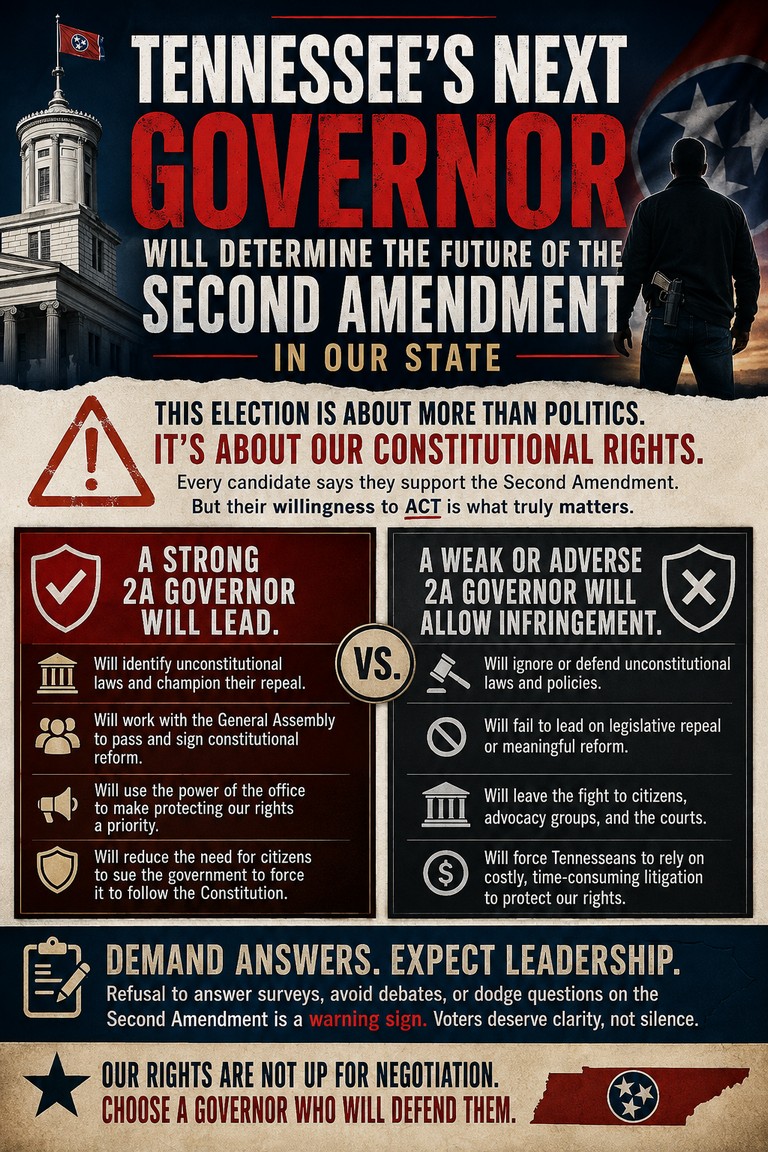
The practical distinction is substantial. A governor who regards the right to keep and bear arms as a binding constitutional limitation can lead an organized effort to bring Tennessee law into constitutional compliance. A governor who is indifferent, hesitant, or hostile to that right can allow doubtful restrictions to remain in the Tennessee Code, leaving affected citizens to challenge those restrictions one case at a time. This is what has been happening during the three decades of TFA’s existence.
Legislative repeal should be the first constitutional remedy. When a statute cannot be reconciled with the Constitution, the preferred solution should be legislative correction. The General Assembly can repeal the statute, narrow its language, replace it with a constitutionally supportable provision, or eliminate administrative practices that extend beyond lawful authority.
That process is generally more direct and comprehensive than litigation. Legislation can address an entire statutory scheme, establish clear rules for citizens and law-enforcement officers, and reduce uncertainty across the state. It can also prevent the public from bearing the cost of prolonged litigation on both sides both through taxes used to defend the law and again through private funds that must be spent to challenge it.
A governor committed to constitutional compliance should not wait passively for courts to identify every defect. The executive branch can review existing statutes, regulations, policies, signage requirements, and enforcement practices. The administration can then submit specific recommendations to the legislature and publicly explain why reform is necessary.
That is leadership within the constitutional system. It recognizes both the legislature’s authority to enact and repeal statutes and the governor’s responsibility to use the influence of the office to promote lawful government.
But weak executive leadership shifts the burden to private citizens. When elected officials – like Bill Lee and Bill Haslam and many of the Republicans in the General Assembly – decline to correct constitutionally doubtful laws, the burden often shifts to individual citizens and nonprofit organizations. Those citizens must find counsel, establish standing, locate appropriate plaintiffs, develop a factual record, retain experts when necessary, survive procedural challenges funded through the state’s use of taxpayer funds, and finance litigation that may continue for years.
Constitutional litigation is rarely simple. Even a successful plaintiff may face substantial legal expenses, uncertainty, delay, and the probability of appeals. During that period, the challenged statute ordinarily will continue to affect conduct, enforcement decisions, and the willingness of citizens to exercise protected rights.
A government that relies on private lawsuits as its principal method of constitutional correction has reversed the proper allocation of responsibility. Indeed, such a government is clearly led by elected officials in open revolt against their own constitutional oaths of office. Quite simply, citizens should not be required to sue the State merely to compel public officials to remain within the limits of delegated authority and to honor their oaths.
Courts are essential when the political branches fail. Judicial review exists precisely because legislative and executive officials may exceed constitutional boundaries. But litigation should be a safeguard against governmental failure, not the State’s preferred substitute for legislative examination and executive leadership.
Hughes v. Lee illustrates the institutional choice. The litigation in Hughes v. Lee illustrates the practical importance of this distinction. A three-judge trial court panel concluded that two broadly applicable Tennessee firearm statutes violated basic and foundational constitutional protections. The State, led by Bill Lee and Attorney General Skrmetti, appealed, thereby extending the dispute and asking an appellate court to preserve the challenged provisions.
Whatever position a candidate takes on the merits, the case presents several questions that should be answered directly. Does the candidate believe the statutes are constitutional? If not, should they be repealed or rewritten? Should Tennessee continue expending taxpayer funds defending them? Should the responsible elected officials who created the problem or failed to correct it be personally held financially accountable or, at a minimum, removed from office? What legislation would the candidate support to address the underlying statutory issues?
These questions concern more than one lawsuit. They reveal how a prospective governor understands the relationship among constitutional rights, legislative boundaries, legislative responsibility, executive leadership, and judicial review.
A candidate who believes the challenged statutes are unconstitutional should be able to explain what lawful action the administration would pursue. A candidate who believes they are constitutional should be willing to defend that conclusion with equal clarity. The public benefits from knowing whether a future administration will seek legislative resolution or leave the dispute to continued litigation.
A governor’s legislative agenda matters.
Governors do not merely comment on legislation after it reaches their desks. They help establish priorities, communicate with committee chairs, negotiate with legislative leadership, authorize state agencies to lobby for or more commonly against reforms, propose administration bills, influence budgetary decisions, and determine which issues receive sustained public attention.
A governor who places constitutional reform near the top of the legislative agenda can materially improve the probability that defective laws will be examined and corrected. That governor can request a systematic statutory review, require executive agencies to identify questionable restrictions, and present the General Assembly with specific repeal or amendment proposals.
By contrast, a governor who avoids the issue can make reform more difficult even without openly opposing it. Legislative inaction may result from silence, delay, competing priorities, administrative resistance, or the unwillingness of executive officials to acknowledge that existing law is constitutionally vulnerable.
The absence of leadership is therefore not merely neutral. It can preserve the status quo and increase the likelihood that courts rather than elected officials will determine when and how Tennessee law is corrected.
Constitutional compliance should not depend on litigation capacity.
A constitutional right should not be effectively available only to citizens who can afford counsel, withstand years of uncertainty, and assume the risks of litigation. The protection of constitutional limits is a responsibility shared by every branch of government. Further, it is a core component of the constitutionally required oath of office that elected officials are required to give.
Legislators should examine whether the laws they enact or even preserve remain constitutionally valid. Executive officials should administer only lawful authority and should recommend reform when existing statutes exceed constitutional limits. Courts should provide relief when the political branches fail to perform those duties and when the political branches have violated their constitutional limits of authority.
The identity and philosophy of the governor therefore has practical consequences. Strong constitutional leadership can reduce unnecessary disputes by promoting and demanding legislative repeal and administrative correction. Weak or adverse leadership can leave doubtful restrictions in place and make private litigation increasingly necessary.
Public accountability requires specific answers. General campaign statements of support for the Second Amendment do not answer these institutional questions. The relevant inquiry is whether a candidate has a concrete plan to identify, repeal, amend, or stop enforcing laws and policies that cannot be defended under the governing constitutional standard.
Candidates should be asked whether they would support a formal review of Tennessee’s firearm laws and executive policies. They should identify any provisions they believe require repeal or amendment. They should explain whether constitutional reform would be included in the administration’s legislative package and whether the governor would actively advocate for passage. These are the types of questions contained in the Tennessee Firearms Association’s 2026 survey.
Candidates should also address what role litigation should play. Will citizens continue to bear the burden of challenging the State in court, or will the administration use the political process to correct constitutional defects before additional lawsuits become necessary? Should successful citizen challenges be awarded legal expenses particularly since the restoration of civil rights and the elimination of unconstitutional laws benefits all citizens?
A candidate’s refusal to provide specific answers does not conclusively establish what a candidate would do in office. It does, however, leave voters without a reliable basis for evaluating how that candidate would exercise executive influence when constitutional rights conflict with existing state law.
The central question is whether government will correct itself. The ultimate issue is not whether constitutional litigation will remain available. It must (even through Tennessee’s Republican controlled legislature tried in 2026 to remove that option entirely). The issue is whether litigation will be necessary because Tennessee’s political leadership refused to act.
A governor committed to constitutional limits can lead the General Assembly toward repeal, amendment, and transparent review. Such leadership can reduce legal uncertainty, conserve public and private resources, and demonstrate that constitutional compliance is an affirmative duty rather than an obligation imposed only after a court order.
A governor who is unwilling to provide that leadership increases the likelihood that citizens will have to seek judicial relief. In that environment, the people must spend their own resources to force the government to remain within powers that were limited from the beginning.
The next governor’s position on the Second Amendment will therefore influence not only the substance of Tennessee law, but also the process by which constitutional violations are corrected. The choice is between proactive constitutional government and a system that waits for citizens to sue before it acknowledges its limits.
A record matters more than a label. Party affiliation is not a substitute for constitutional conviction. Endorsements are not a substitute for analysis. Advertising is not a substitute for a record, and repeated declarations of support are not a substitute for a concrete governing plan.
Voters should examine whether a candidate has answered detailed surveys, participated in substantive debates, addressed Hughes v. Lee, identified specific laws or policies requiring reform, identified incumbents who have been blocking reform efforts, and explained how executive authority would be used. They should distinguish between a candidate who has taken clear positions and one who has relied on carefully managed ambiguity or worse silence.
The warning signs are not difficult to recognize. A candidate refuses written questions, avoids debates, declines to discuss pending constitutional litigation, identifies no existing restriction that should be changed, and offers no timetable for action. Yet such candidates often claim the mantle of a committed Second Amendment defender.
That combination should not reassure voters. It should concern them.
Constitutional rights require more than ceremonial support. The Second Amendment is not campaign decoration, political branding, a “grade” to be purchased, or a ceremonial phrase to be displayed during an election and forgotten after inauguration. It is a restraint on government power and a guarantee belonging to the people.
Tennessee’s next governor should be willing to explain, before the election, what that guarantee requires in practice. A candidate should be prepared to identify unconstitutional restrictions, oppose improper state action, pursue lawful reform, and accept public accountability for the results.
Voters should demand those answers now, while candidates are still seeking their consent. After the votes are counted and the power of the office has been transferred, silence becomes far more difficult and far more expensive to correct.
Sorry, comments are closed for this post.