
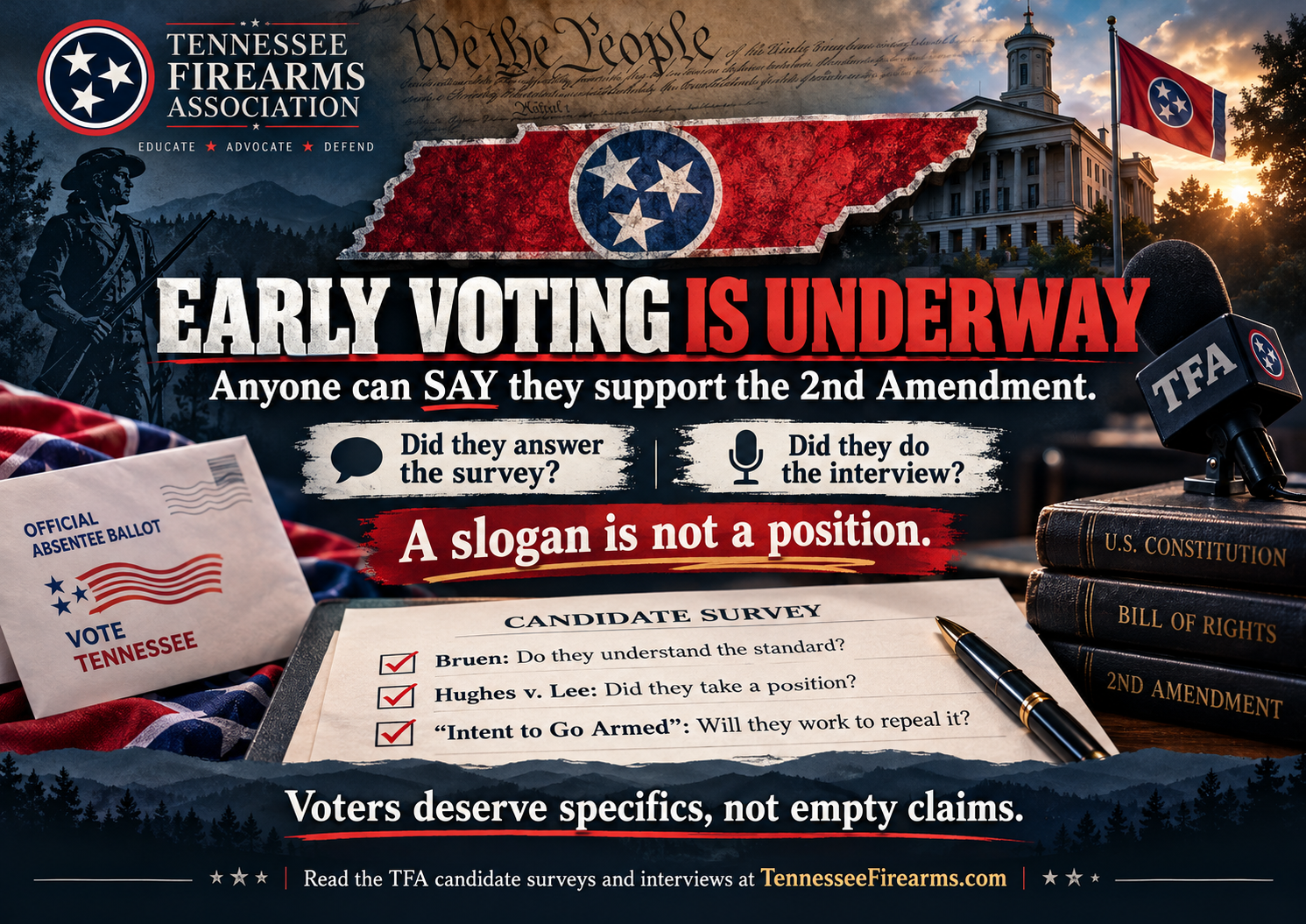
Tennessee’s early voting has started. Before casting your ballot, find out which candidates are willing to answer serious questions about your constitutional rights—and which are not. Then you decide who has earned your vote.
Early voting is underway in Tennessee for the November 2026 general election. Candidates across the state are telling voters that they support the Second Amendment, believe in constitutional rights, and will defend our freedoms. Those are familiar campaign promises. They sound good in speeches, look good on campaign mailers, and make excellent slogans. Many are not even the actual words of the candidates but are coached or added by paid consultants. But there is a serious problem with those claims: Unless a candidate explains exactly what those statements mean, voters have no reliable way to determine whether the candidate actually supports the rights that the Second Amendment protects.
Almost any candidate can claim to support the Second Amendment. Republicans, Democrats, independents, socialists, and even politicians who advocate extensive restrictions on firearms can make that statement. The difference is often hidden in what each politician believes the Second Amendment actually protects. Does it protect the right of ordinary citizens to carry firearms for self-defense without first obtaining government permission? Does it protect that right in public places? Does it prevent the government from treating the exercise of a constitutional right as a criminal offense? Or does the candidate believe that government officials should have broad authority to decide when, where, and how citizens may exercise that right? Those are very different positions, even though the politicians holding them might all claim to support the Second Amendment.
We have seen politicians play these word games before. Remember President Bill Clinton’s attempt to defend his statements about his relationship with a White House intern by arguing over the meaning of the word “sex”? The public understood what the words ordinarily meant, but Clinton tried to escape accountability by assigning them a convenient definition. The same problem arises when politicians claim to support the Second Amendment while refusing to explain what they believe it means. A politician who says “I support the Second Amendment” while reserving the right to define that support however it suits the moment has told voters almost nothing. Whether that is intentional deception or simply political evasion, the result is the same. Just look at the last 15 years of a Republican super majority in the legislature – a super majority in which at least most of the caucus members would claim to be 2nd Amendment supporters – but in reality are not and Tennessee’s current statutes prove it.
TFA Asked the Questions. Some Candidates Answered. Many Did Not.
Earlier this year, Tennessee Firearms Association distributed a detailed, 27-question written survey to candidates for governor and the Tennessee General Assembly. These were not trick questions or vague requests for candidates to declare whether they liked the Second Amendment. They were specific questions about Tennessee laws, constitutional protections, proposed legislative changes, and the authority of government officials to restrict the rights of citizens. TFA published the questions and the responses it received so voters could examine the candidates’ actual positions rather than relying on campaign slogans.
Some candidates took the time to respond. Others did not. TFA also offered gubernatorial candidates opportunities to participate in recorded interviews addressing specific Second Amendment issues. Candidates were provided the questions in advance, and the interview process was designed to give participants an opportunity to explain their positions without surprise questions. Some accepted those invitations and made their positions part of the public record. Others declined or simply failed to respond. Those differences matter because the candidates who answered have given voters something specific against which their future conduct can be measured.
Failing to answer a survey does not necessarily establish that a candidate opposes the Second Amendment. But neither does claiming to support the Second Amendment establish that the candidate will defend it or what the candidate will do. When candidates are given reasonable opportunities to explain their positions on serious constitutional questions and choose not to do so, voters are entitled to consider that lack of transparency. They are also entitled to ask why a candidate who is willing to spend substantial amounts of money advertising support for the Second Amendment is unwilling to answer specific questions about what that support means.
Tennessee’s “Intent to Go Armed” Law: A Question Every Candidate Should Answer
One of the most significant issues confronting Tennessee gun owners is Tennessee Code Annotated § 39-17-1307(a), commonly known as the “intent to go armed” law. Despite years of politicians celebrating what they call “constitutional carry,” Tennessee has retained a criminal statute that makes carrying a firearm with the intent to go armed an offense, subject to statutory exceptions and defenses. Tennessee Code Annotated §§ 39-17-1307 and 39-17-1308 contain provisions addressing when conduct falls within an exception or when a defendant may assert a defense. But those provisions do not eliminate the underlying criminal prohibition. Tennessee intentionally makes the exercise of a constitutionally protected right a crime and puts the burden on the citizen at trial to prove that her conduct met one of small list of legislatively created defenses.
That distinction is important. TFA has argued for years that a constitutionally protected right should not be treated as a crime in the first instance, with citizens forced to depend on legislative exceptions or defenses to avoid criminal liability. The General Assembly has had numerous opportunities to repeal or fundamentally restructure the statute. Yet the underlying “intent to go armed” prohibition remains part of Tennessee law, notwithstanding the repeated claims that Tennessee has enacted constitutional carry.
Every candidate seeking to become governor or a member of the General Assembly should be willing to answer a simple question: Will you work to repeal Tennessee’s “intent to go armed” criminal statute and replace the existing structure with legislation that recognizes the right of ordinary, law-abiding citizens to bear arms as a constitutional right rather than a legislative privilege? A candidate who claims to support constitutional carry but refuses to address that statute has avoided one of the most important Second Amendment issues facing Tennessee citizens.
Hughes v. Lee: Where Do the Candidates Stand?
Tennessee voters also have good reason to ask candidates about Hughes v. Lee, the constitutional lawsuit brought by three TFA members, Gun Owners of America, and Gun Owners Foundation. That litigation challenges Tennessee’s “intent to go armed” statute and its restrictions on carrying firearms in parks and certain public recreational areas. In August 2025, a three-judge Tennessee trial court panel declared the challenged statutes unconstitutional. The State appealed, and the trial court’s judgment was stayed pending appellate review. The Tennessee Court of Appeals heard oral argument on June 23, 2026 but has not issued its ruling as of October 16, 2026.
This litigation raises questions that go directly to the responsibilities of Tennessee’s governor and legislators. Should the State continue defending laws that citizens contend violate the Second Amendment and the Tennessee Constitution? Should the General Assembly act to repeal the challenged restrictions regardless of the eventual outcome of the appeal? Should the government continue spending taxpayer money defending those statutes, or should elected officials recognize that their oath requires them to respect constitutional limits even when those limits interfere with their preferred policies?
These are not abstract academic questions. They concern existing Tennessee statutes, an actual constitutional lawsuit, and the rights of Tennessee citizens. Candidates seeking legislative or executive authority should have considered these issues and should be prepared to explain their positions. A candidate who claims to be a strong defender of the Second Amendment but refuses to take a position on the legal and legislative issues raised by Hughes v. Lee leaves voters without meaningful evidence of what that promise actually means.
Bruen: The Supreme Court Has Already Explained the Constitutional Standard
In 2022, the United States Supreme Court decided New York State Rifle & Pistol Association v. Bruen, 597 U.S. 1 (2022). The Court confirmed that the Second Amendment protects the right to carry firearms publicly for self-defense and rejected the use of judicial interest-balancing tests to determine whether firearms restrictions are constitutional. Under Bruen, when the Second Amendment’s plain text covers an individual’s conduct, that conduct is presumptively protected, and the government must justify a restriction by demonstrating consistency with the Nation’s historical tradition of firearm regulation.
That decision matters because politicians often defend firearms restrictions by arguing that the restrictions are reasonable, popular, or necessary for public safety. But under Bruen, those policy arguments alone do not satisfy the constitutional standard. Government officials must respect the limits imposed by the Constitution, even when they believe a different policy would be preferable. The Supreme Court has recognized that historical firearms regulations may support certain restrictions, but the government cannot simply substitute its preferred policy judgment for the constitutional analysis.
Tennessee candidates should therefore be willing to explain whether they accept the constitutional framework announced in Bruen and how they believe it applies to Tennessee’s existing firearms laws. Do they believe the State’s broad “intent to go armed” prohibition is consistent with that decision? Do they believe Tennessee’s restrictions on carrying firearms in parks are constitutional? If they believe those restrictions are valid, what historical basis supports that conclusion? If they believe the restrictions are unconstitutional, what will they do, within the lawful authority of the office they seek, to correct the problem?
These questions distinguish candidates who have seriously considered the constitutional rights of Tennessee citizens from candidates who offer little more than political advertising. A candidate does not have to be a constitutional scholar to answer them, but someone asking voters to entrust them with the power to make or execute laws should be willing to explain how that power will be exercised.
Is It Support for the Second Amendment—or Just a Campaign Strategy?
Political consultants understand that the Second Amendment matters to Tennessee voters. That is why candidates frequently advertise themselves as strong defenders of gun rights, pose for photographs with firearms, seek endorsements, and use carefully crafted language intended to appeal to gun owners. But advertising a position is not the same as demonstrating a commitment to it. A photograph with a firearm does not establish that a candidate understands the Constitution, and a campaign slogan does not establish what laws the candidate will support or oppose.
Political consultants, perhaps such as Ward Baker, are paid or otherwise compensated (some may even be purely volunteers) to help candidates win elections. Their job is to manage campaign messaging, attract votes, and avoid unnecessary political risks. That often means emphasizing broad statements that appeal to voters while avoiding detailed commitments that could later create controversy or accountability. From the perspective of a campaign consultant, refusing to answer specific questions may be an effective way to avoid taking a position. From the perspective of voters seeking trustworthy public officials, however, that same refusal may be an important warning sign.
The danger is that voters may elect candidates based on what they assume the candidates believe rather than on what those candidates have actually promised to do. Once elected, those politicians may claim that they support the Second Amendment while voting against legislation that would repeal unconstitutional restrictions, opposing meaningful reforms, or refusing to challenge government actions that infringe the rights of citizens. When voters later object, the politicians can insist that they never promised to support those particular changes. That is precisely why detailed answers and documented commitments matter before the election, not merely afterward.
Your Vote. Your Decision. But Get the Facts First.
TFA does not ask its members to vote blindly for a party label, campaign slogan, or candidate’s claim of constitutional loyalty. Nor does participation in a TFA survey or interview automatically establish that a candidate deserves anyone’s vote. A written answer is a commitment that can be examined, compared with a candidate’s record, and used to demand accountability. It is not a guarantee of future performance. But it provides substantially more information than an unsupported promise that the candidate supports the Second Amendment.
Before voting, TFA encourages every member and supporter to review the published candidate surveys and interviews. Find out whether the candidates on your ballot answered TFA’s questions. Consider whether their answers address the actual constitutional issues facing Tennessee. Examine their voting records and prior public statements where those records exist. Determine whether they have taken clear positions on Bruen, Hughes v. Lee, and Tennessee’s “intent to go armed” statute. If a candidate has not provided those answers, ask why. Then decide for yourself how much weight to give the candidate’s silence.
Tennessee citizens should not have to guess what a candidate means by supporting the Second Amendment. They should not have to depend on campaign consultants to define constitutional rights or wait until after an election to discover whether a politician intends to protect those rights. The Constitution is not a marketing slogan, and the right to keep and bear arms is not a political favor to be granted or withheld by whichever party happens to control the government.
Early voting is underway. Before you cast your ballot, demand more than slogans, photographs, endorsements, and vague promises. Look for specific answers, clear commitments, and a record of constitutional stewardship. The decision belongs to each voter, but that decision should be based on facts—not political advertising.
Review TFA’s 2026 Candidate Surveys and Interviews
Governor candidate survey:
https://tennesseefirearms.com/2026/06/tfa-2026-candidate-survey-for-tennessee-governor/
Tennessee Legislature candidate survey:
https://tennesseefirearms.com/2026/07/tfa-2026-candidate-survey-for-tennessee-legislature/
2026 General Election — Governor candidate interview invitations and responses:
https://tennesseefirearms.com/2026/10/tfa-invites-governor-candidates-to-participate-in-live-2nd-amendment-interviews/
Republican gubernatorial primary candidate interviews:
https://tennesseefirearms.com/2026/07/tfa-interviews-republican-gubernatorial-candidates-well-it-tried-to/
The Tennessee Firearms Association provides candidate surveys and interviews for voter information and independent evaluation. Participation or nonparticipation should not be construed as a TFA endorsement or opposition to any candidate.
Sorry, comments are closed for this post.