
TFA Amicus Position Vindicated as Court Rejects Post-Bruen Efforts to Make Carry Permits Practically Worthless
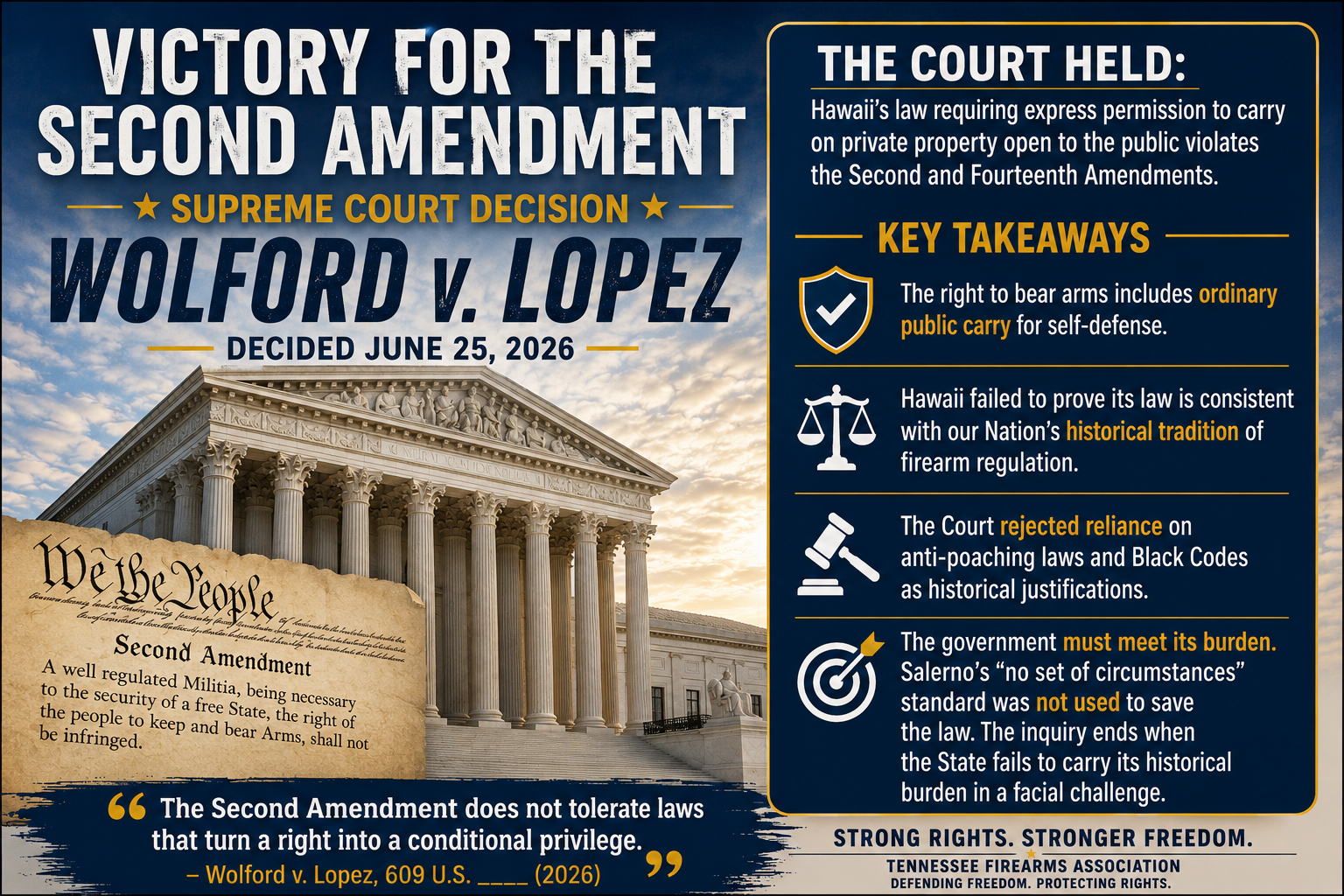
On June 25, 2026, the United States Supreme Court issued its decision in Wolford v. Lopez, holding that Hawaii violated the Second and Fourteenth Amendments by prohibiting licensed carry permit holders from carrying handguns on private property open to the public unless the property owner gave express permission. The decision is an important victory for the right to bear arms outside the home. It also reinforces principles that may be relevant to Second Amendment litigation across the country, including the pending appeal in Tennessee in Hughes v. Lee.
What Hawaii Tried to Do
After the Supreme Court’s 2022 decision in New York State Rifle & Pistol Association v. Bruen, Hawaii could no longer maintain a licensing system that made public carry nearly impossible for ordinary citizens. Hawaii responded by adopting new restrictions that, in practical effect, continued to burden lawful carry. The law challenged in Wolford flipped the ordinary rule for private property open to the public. Traditionally, a person may enter businesses and other property held open to the public unless the owner says otherwise. Hawaii reversed that rule for licensed firearm carriers. Under Hawaii’s statute, a licensed person carrying a firearm could not enter private property open to the public unless the property owner gave express authorization, either by signage or by clear written or verbal permission.
That meant a license holder could face criminal liability for ordinary daily activities such as stopping at a gas station, entering a restaurant, shopping at a grocery store, going to a pharmacy, or visiting other businesses that did not affirmatively post “guns welcome” signage.
The Supreme Court rejected that approach.
The Wolford Holding
The Supreme Court held that Hawaii’s express-permission requirement for carrying firearms on private property open to the public violates the Second and Fourteenth Amendments. The Court applied the same basic framework used in Heller and Bruen. First, the Court asked whether Hawaii’s law regulated conduct covered by the plain text of the Second Amendment. It did. The petitioners were among “the people,” they sought to “bear” arms, and they sought to carry handguns for self-defense.
Once that threshold was met, Hawaii’s law was presumptively unconstitutional unless the State could prove that the restriction was consistent with the Nation’s historical tradition of firearm regulation. Hawaii failed to carry that burden.
The Court rejected Hawaii’s reliance on colonial and early state anti-poaching laws. Those laws addressed unauthorized hunting on another person’s land. They were designed to prevent poaching, theft of game, property damage, and risks associated with firing guns while hunting. They were not laws barring peaceable concealed carry for self-defense in ordinary businesses and other places open to the public.
The Court also rejected Hawaii’s reliance on an 1865 Louisiana statute enacted as part of the Black Codes. The Court explained that the Black Codes were designed to disarm Black citizens and leave them defenseless. Such laws cannot legitimately define the scope of the constitutional right to keep and bear arms.
Why the Absence of the Supreme Court’s 1987 Salerno Decision Matters
Wolford is also important for what it did not do. The Court did not rely on the “no set of circumstances” language from United States v. Salerno to avoid deciding the Second Amendment question. Nor did it uphold Hawaii’s law by asking whether some imagined application of the statute might be valid.
That omission matters because some governments have argued that facial challenges to firearm statutes should fail unless the plaintiff can prove that the law is invalid in every conceivable application. The Supreme Court did refer to that standard in United States v. Rahimi, but Rahimi involved a different statute and a different record. There, the Court held that the federal statute disarming persons subject to certain domestic-violence restraining orders was constitutional as applied to Rahimi because Rahimi had been judicially found to pose a credible threat to another person’s safety and the government identified historical analogues supporting temporary disarmament of dangerous persons.
Wolford proceeded differently. Once the Court found that Hawaii’s law burdened conduct covered by the Second Amendment, the case turned on whether Hawaii carried its historical burden under Bruen. Hawaii did not. The Court then held the law unconstitutional without asking whether the State could save the statute by hypothesizing some valid application.
Wolford therefore supports an important Second Amendment principle: when a firearm law burdens conduct covered by the plain text of the Second Amendment, the government must prove a relevant national historical tradition. Salerno should not be used as a shortcut around that burden. Nor should it be used to preserve a statute that fails Heller and Bruen simply because a government lawyer can imagine a narrower law that might have been constitutional.
TFA’s Amicus Position
Tennessee Firearms Association joined an amicus brief in Wolford supporting the challengers. That brief argued, among other things, that racist and discriminatory Black Codes do not establish a valid historical tradition of firearm regulation and should not be used to justify modern restrictions on Second Amendment rights. The Supreme Court’s opinion substantially vindicates that argument. The Court specifically rejected Hawaii’s reliance on the Louisiana Black Code, holding that it carried no weight as a constitutional analogue. Justice Barrett’s concurrence was even more direct, explaining that laws enacted to subordinate newly freed slaves cannot justify modern restrictions on the right to bear arms.
Why Wolford Matters
Wolford confirms several important points. First, the Second Amendment protects the right to carry arms for self-defense as citizens go about ordinary daily life. The right is not confined to the home, and a state may not make carry permits functionally useless by banning carry across broad areas of normal public activity.
Second, governments may not use local attitudes, policy preferences, or generalized opposition to firearms as a basis for reducing constitutional protections. The Court made clear that the Second Amendment has the same meaning in every state.
Third, the Court reaffirmed that interest balancing is not the test. The government cannot justify firearm restrictions merely by asserting public-safety concerns. Under Bruen, the government must identify a relevant historical tradition that is meaningfully similar in both how and why it burdened the right to keep or bear arms.
Fourth, historical analogues must actually fit. Anti-poaching laws aimed at unauthorized hunting on rural land did not justify a modern law barring licensed self-defense carry in gas stations, grocery stores, restaurants, drug stores, and other ordinary places open to the public.
Fifth, courts should not rely on racially discriminatory Reconstruction-era laws, including Black Codes, to define the scope of constitutional rights. The Fourteenth Amendment was adopted to secure liberty, including the right to keep and bear arms, against hostile state action—not to constitutionalize the very abuses it was designed to overcome.
Impact on Tennessee
Wolford does not directly strike down any Tennessee statute. The Hawaii law at issue was a specific express-permission rule for carrying firearms on private property open to the public. Tennessee’s statutory scheme is different.
However, Wolford is important for Tennessee because it strengthens the controlling constitutional framework that applies to all states, including Tennessee. Tennessee may not defend firearm restrictions by relying on generalized public-safety balancing, isolated historical outliers, local policy preferences, or historical laws that are not meaningfully analogous to the modern restriction being challenged.
The decision also confirms that when a firearm law burdens ordinary, peaceable carry for self-defense, courts must take that burden seriously. A law that makes the exercise of the right impractical in ordinary daily life cannot be saved simply by recharacterizing it as a regulation of place, property, procedure, or public safety.
Potential Impact on Hughes v. Lee
The pending appeal in Hughes v. Lee challenges Tennessee statutes including Tennessee Code Annotated § 39-17-1307(a), commonly known as the “intent to go armed” statute, and Tennessee Code Annotated § 39-17-1311, commonly known as the “parks” statute. The plaintiffs allege that these statutes infringe rights protected by the Tennessee Constitution, the Second Amendment, and the Fourteenth Amendment.
Wolford does not decide Hughes. It does not automatically invalidate the Tennessee statutes at issue. But it provides additional Supreme Court authority that may assist the Hughes plaintiffs in several respects. Wolford reinforces that the right to bear arms includes ordinary public carry for self-defense. It also reinforces that when the plain text of the Second Amendment covers the conduct at issue, the burden shifts to the government to prove a relevant historical tradition supporting the challenged restriction. The government must do more than cite broad policy concerns or loosely related historical laws.
Wolford may also matter to the facial-challenge issue in Hughes. Tennessee argues that the challenged statutes survive because there may be some valid applications such as when people carry grenades or when felons carry a firearm. But those types of arguments were not even distinguished in Wolford and the Hughes plaintiffs can point to Wolford’s actual method of analysis. The Court did not use Salerno to avoid the Second Amendment inquiry. It asked whether the regulated conduct fell within the Second Amendment and whether the State carried its historical burden. When Hawaii failed that burden, the law fell.
That does not mean Wolford expressly overruled Salerno. It did not. But Wolford strongly supports the argument that, in Second Amendment cases, Salerno cannot replace the Heller/Bruen inquiry. If the challenged statute burdens conduct protected by the Second Amendment and the State cannot prove a relevant historical tradition, the statute cannot be saved merely by hypothesizing circumstances in which some different or narrower restriction might be valid.
For Hughes, that point may be significant. The appellate court should decide whether Tennessee has carried its burden under the governing Second Amendment framework. If Tennessee cannot identify a representative, well-established national historical tradition supporting the challenged restrictions, then the constitutional inquiry should not be diverted by generalized assertions of possible valid applications.
Bottom Line
Wolford is a major Second Amendment decision. The Supreme Court rejected a post-Bruen law that attempted to make lawful public carry difficult, risky, and impractical for ordinary citizens. The Court reaffirmed that the right to bear arms for self-defense is a real constitutional right, not a privilege that states may hollow out through regulatory workarounds. Wolford is also important because the Court did not dilute Bruen with a separate Salerno escape hatch. The State had the burden to justify its law through history and tradition. It failed.
For TFA members and Second Amendment supporters, Wolford is a strong reminder that litigation matters. TFA participated as amicus in this case because the principles at stake extend beyond Hawaii. Those same principles are important in Tennessee, including in the continuing appeal in Hughes v. Lee.
TFA will continue working to ensure that Tennessee’s laws comply with both the Tennessee Constitution and the Second and Fourteenth Amendments to the United States Constitution. After all, Tennessee’s governors and its Republican dominated Legislature don’t seem the least bit concerned that their actions violate the 2nd Amendment – as the State has stated in Hughes v. Lee.
Sorry, comments are closed for this post.